How Poker Betting Strategy Works
Sound poker betting comes down to one rule: every bet should have a clear purpose. There are three reasons to put chips in — value (getting called by worse hands), bluffing (making better hands fold), and denying equity(charging draws to continue). Match your bet size to that purpose, and if you can't name the reason before you bet, check or fold instead.
Why Betting Strategy Matters
In poker, you make money not by getting dealt the best cards, but by making the best decisions with whatever cards you have. Betting is the primary way you express those decisions. A well-timed bet can extract maximum value from a strong hand, protect your equity against draws, or convince an opponent to fold a better hand. A poorly timed bet wastes chips and gives away information.
Most beginners focus on which hands to play. Intermediate and advanced players focus on how to play them — and that starts with understanding betting strategy. Every bet you make should have a clear purpose: are you betting for value, as a bluff, or to deny equity? If you cannot answer that question before putting chips in, you are gambling, not playing poker.
The Three Reasons to Bet
Every profitable bet falls into one of three categories. Before you put a single chip into the pot, identify which category your bet belongs to:
1. Value Betting
A value bet is a bet made with a hand you believe is ahead of your opponent's calling range. You want to be called because you expect to win more often than you lose. Value betting is where the majority of your poker profit comes from.
The key question for value betting is: "What worse hands will call me?" If you cannot name at least a few hands that are worse than yours and would realistically call, then you are not value betting — you are turning your hand into a bluff.
2. Bluff Betting
A bluff bet is made with a hand you believe is behind your opponent's range. You want opponents to fold. The profitability of a bluff depends on how often your opponent folds versus the price you are laying yourself. For a detailed breakdown, see our guide to bluffing.
3. Denial / Protection Betting
Sometimes you bet to deny your opponent the chance to see a free card that could beat you. If you hold a moderate hand like top pair with a weak kicker on a draw-heavy board, betting forces drawing hands to pay to continue. Even if they call, you are charging them a price — and that price adds up over thousands of hands.
Bet Sizing: The Numbers That Matter
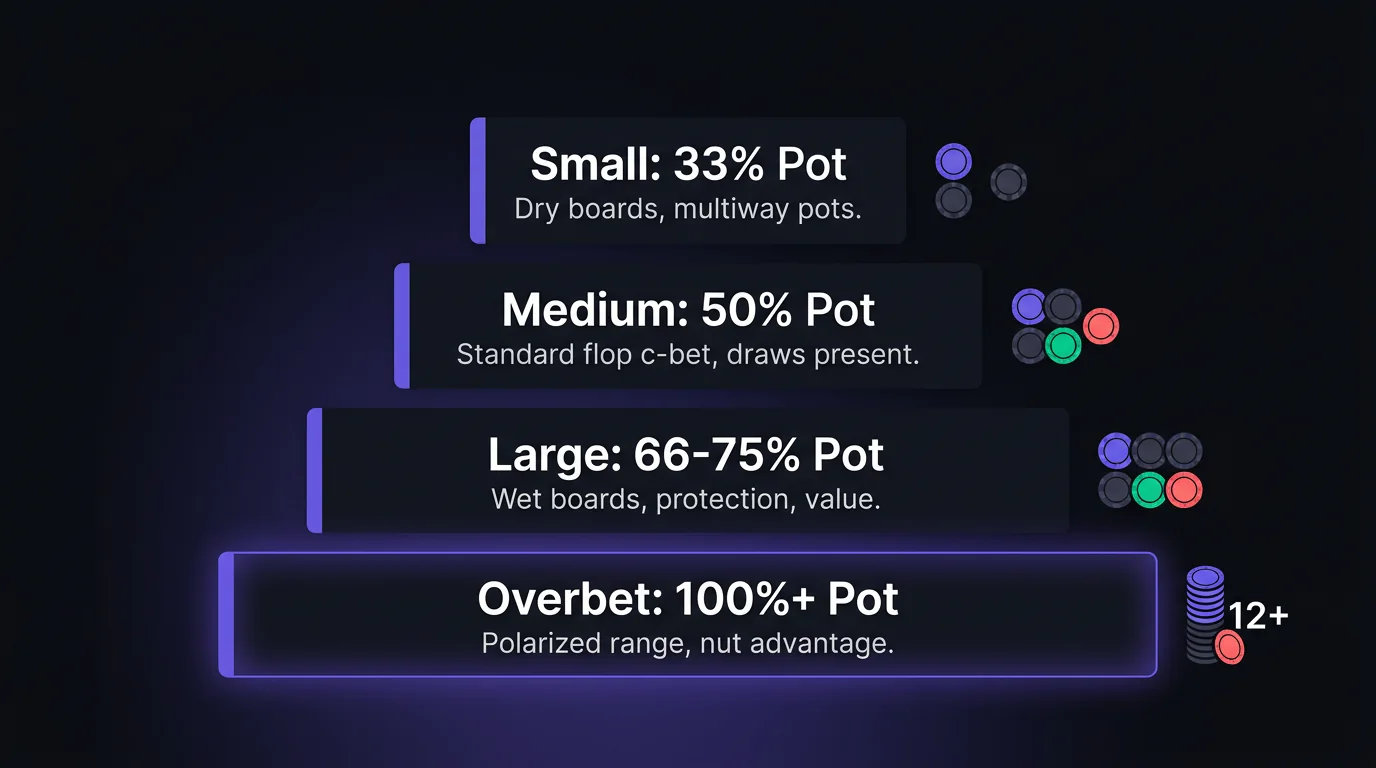
How much you bet matters just as much as whether you bet. Different sizes accomplish different goals. Here are the standard bet sizes and when to use each:
Small Bet: One-Third Pot (33%)
A small bet is useful in several situations:
- C-betting dry flops — on boards like K♦ 7♠ 2♣ where draws are scarce, a small bet is enough to get folds from hands that missed. You risk less when your opponent does have something.
- Thin value on the river — when you have a marginal hand that is slightly ahead, a small bet can extract a call from worse hands that would fold to a bigger size.
- Blocking bets — betting a small amount from out of position to prevent your opponent from making a larger bet. This gives you a cheaper way to see a showdown.
Medium Bet: Half Pot (50%)
The half-pot bet is the most versatile size in poker. It works for value, bluffs, and protection across all streets. It is large enough to put pressure on draws but small enough that you do not overcommit with marginal hands.
- Default c-bet size — half pot works on most flop textures as a continuation bet
- Turn barrel — following up your flop bet with a half-pot turn bet maintains pressure without bloating the pot
- Multi-way pots — when betting into multiple opponents, a smaller size is appropriate because your range needs to be stronger
Large Bet: Two-Thirds to Three-Quarters Pot (66-75%)
Larger bets are for when you want to build the pot with strong hands or put maximum pressure on your opponent's range:
- Value betting strong hands — when you have the nuts or near-nuts, you want the pot to grow as fast as possible
- Wet board c-bets — on draw-heavy boards like J♥ 10♥ 8♠, a larger bet charges draws a higher price to continue
- River bluffs and value — on the final street, a two-thirds pot bet is the standard for both bluffs and value
Overbet: More Than Pot (100%+)
Overbets are an advanced tool that most players underuse. Betting more than the pot is powerful in polarized situations where you either have a very strong hand or nothing:
- Nut advantage spots — when you can have the strongest possible hands and your opponent cannot, overbetting puts them in an extremely difficult position
- River pressure — a 1.5x pot overbet on the river forces your opponent to be right a very high percentage of the time to call profitably
Continuation Betting (C-Bets)
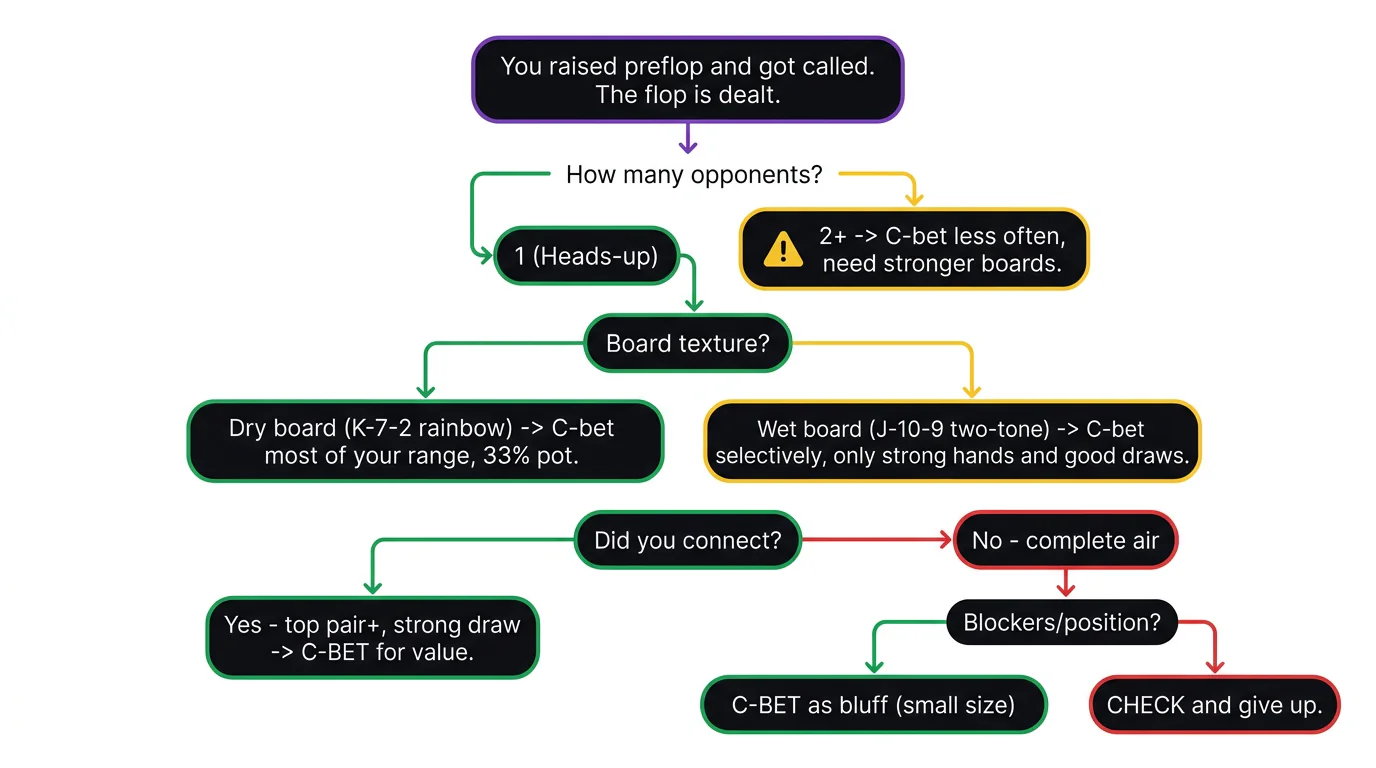
The continuation bet is the most common and fundamental post-flop bet in poker. After you raise preflop and get called, you bet the flop regardless of whether the flop helped your hand. This works because:
- You have the initiative — your preflop raise told a story of strength, and the c-bet continues it
- The flop misses most hands most of the time — your opponent will have nothing they want to continue with roughly 60% of the time
- You have position (usually) — acting last gives you more information and more control
When to C-Bet
- Heads-up pots — c-bet frequently (60-70% of the time) when you are heads-up in position
- Dry, high-card boards— boards like A♦ K♠ 4♣ or Q♥ 7♦ 2♠ strongly favor the preflop raiser's range
- When you have equity — even if the flop did not give you a made hand, overcards, backdoor draws, or gutshots give you reasons to bet
When to Skip the C-Bet
- Multi-way pots — with three or more players seeing the flop, someone almost certainly connected. Tighten your c-bet range significantly.
- Low, connected boards— boards like 8♥ 7♠ 6♦ favor the caller's range more than yours. They called preflop with suited connectors and small pairs, and these boards hit those hands.
- When you have nothing and no equity — if you have 5♣ 4♣ on a K♦ Q♥ 9♠ board with no backdoor draws, there is no reason to put more money in. Give up and save your chips.
Check-Raising
A check-raise is one of the most powerful moves in poker. You check to the aggressor, they bet, and then you raise. It builds massive pots and represents extreme strength. Here is when and why to use it:
Check-Raise for Value
When you flop a strong hand out of position — a set, two pair, or a very strong draw — check-raising lets you build the pot faster than calling. If you just call, the pot grows slowly. If you check-raise, you often double or triple the amount of money going in on the flop.
Check-Raise as a Bluff
Check-raising as a bluff is most effective with strong draws. If you have a flush draw or an open-ended straight draw, a check-raise gives you two ways to win: your opponent folds immediately, or you hit your draw if they call. The raise also sets up larger bets on later streets that can finish the job.
Donk Betting
A donk bet is a bet made by the out-of-position player into the preflop aggressor — essentially "leading into the raiser." Traditional poker wisdom says this is always a mistake, but modern theory has found spots where it is correct:
- Low, connected boards from the big blind— boards like 6♥ 5♦ 4♠ favor the big blind's range because they called with hands like 7-6, 5-4, and 3-3 that smash these boards
- When the turn or river changes things — if a card completes an obvious draw, leading out can put the preflop raiser in a tough spot
For most players at intermediate stakes, avoiding donk bets is still the safer default. Check to the aggressor and either call, raise, or fold. Add donk bets to your arsenal only when you understand the range dynamics well enough to know you have an advantage.
Probe Bets
A probe bet is a bet made on the turn (or river) after the preflop aggressor declines to c-bet the flop. When your opponent checks back the flop, it usually means they do not have a strong hand. A probe bet exploits this weakness.
- Size: Half pot is standard for probe bets — it puts enough pressure to take down the pot but does not risk too much
- Frequency: You can probe with a wide range — middle pairs, weak top pairs, draws, and even air that picked up some equity
- Best on scare cards: If an Ace or King hits the turn and your opponent checked back the flop, a probe bet on the scare card is extremely effective
Position-Based Bet Sizing
Your position at the table should influence both whether you bet and how much you bet. Here are the key principles:
In Position (IP)
- You can use smaller bet sizes because you get to act last on every street — the positional advantage itself is worth money
- You can bet more frequently with a wider range because your opponent cannot check-raise you without risk
- On the river, you can size your bets more precisely because you have seen all of your opponent's actions
Out of Position (OOP)
- Use larger bet sizes when you do bet — you need to compensate for the disadvantage of acting first
- Bet less frequently — check more often to avoid building pots you cannot control
- Lean toward check-raising with your strongest hands and draws rather than leading out
When to Fold: The Discipline That Wins
Folding is the most undervalued skill in poker. Recreational players lose far more money from calling when they should fold than from missing value bets. Here are clear signals that it is time to fold:
- The pot odds do not justify calling — if you need to call $50 into a $60 pot with only a gutshot, the math says fold
- A tight player raises big on the river — when someone who rarely bluffs puts in a large river raise, believe them. Your top pair is not good.
- You are getting raised on multiple streets — facing aggression on the flop, turn, and river usually means you are against a hand that has you crushed
- The board gets worse for your hand— if you had top pair on the flop but the turn and river bring flush and straight completions, your hand's relative strength has decreased dramatically
- You are unsure and the bet is large — when in doubt against a large bet, folding is almost always the correct default. You do not need to win every pot to be a winning player.
Putting It All Together: A Street-by-Street Framework
Here is how to approach betting decisions on each street:
Preflop
- Open-raise to 2.5-3 big blinds from most positions — do not limp
- Three-bet (re-raise) for value with premium hands and as a bluff with suited connectors and suited aces
- Fold weak hands rather than calling raises out of position
Flop
- C-bet about 60% of the time heads-up in position, less frequently multi-way
- Use smaller sizes on dry boards, larger sizes on wet boards
- Check-raise your strongest hands and best draws from out of position
Turn
- Continue betting (double-barrel) with strong hands and draws that picked up equity
- Give up on bluffs that did not improve and have little chance of getting a fold
- Size up slightly from your flop bet — half to two-thirds pot is standard
River
- Value bet when you can name worse hands that would call
- Bluff when your hand has no showdown value and you can tell a credible story
- Check and give up when you have marginal showdown value — checking is free and your hand might win without betting
Common Betting Mistakes to Avoid
- Betting without a plan.Every bet should answer the question "What am I trying to accomplish?" If you do not have an answer, check.
- Using the same size in every situation. A player who always bets half pot is easy to play against. Vary your sizing based on board texture, hand strength, and your opponent.
- Not adjusting to opponents. Against a calling station, bet bigger for value and never bluff. Against a tight player, bluff more and extract thinner value.
- Slow-playing too often. When you flop a monster, the default should be to bet — not to check and hope your opponent catches up. Slow-playing gives free cards and loses value.
- Ignoring pot odds when facing a bet. Before calling any bet, calculate your pot odds and compare them to your equity. If the math does not work, fold.
Put Your Betting Strategy to the Test
Theory is important, but real improvement comes from playing real hands. Deep Poker connects you to real games at every stake level so you can practice value betting, c-betting, and sizing in actual gameplay — most via the ClubGG real-money path.
Start Playing on Deep PokerWhat to Learn Next
Betting strategy works best when combined with a deeper understanding of the other pillars of poker. Continue your learning with these related guides:
- Pot Odds Explained — learn the math behind every calling and folding decision
- Bluffing in Poker — master when and how to bluff profitably
- Table Positions — understand how position shapes every betting decision
- Reading Opponents — adjust your bets based on what your opponents are telling you
- Hand Rankings — make sure you know the value of every hand before betting it
- Poker Terms: A Complete Glossary — the betting vocabulary this guide leans on, spelled out